Knowing our names
Esplanade meaning: ‘a long, open, level area, typically beside the sea, along which people may walk for pleasure’.
Embankment meaning a thick wall of earth that is built to carry a road or railway over an area of low ground, or to prevent water from a river or the sea from flooding the area.
Margaret Mncadi Avenue meaning… the road beside the harbour in Durban that used to be Victoria Embankment. Name changes could have been part of a process of decolonisation. However, there was virtually no public education about the ‘new’ names.
Whole countries were indoctrinated about Queen Victoria, various other monarchs and their offspring for whom streets were named in the countries they colonised, oppressed and plundered.
Very few people have been educated about Margaret Mncadi even in the country where she was born.
Hours of online research yield sparse information, scattered across websites and news reports.
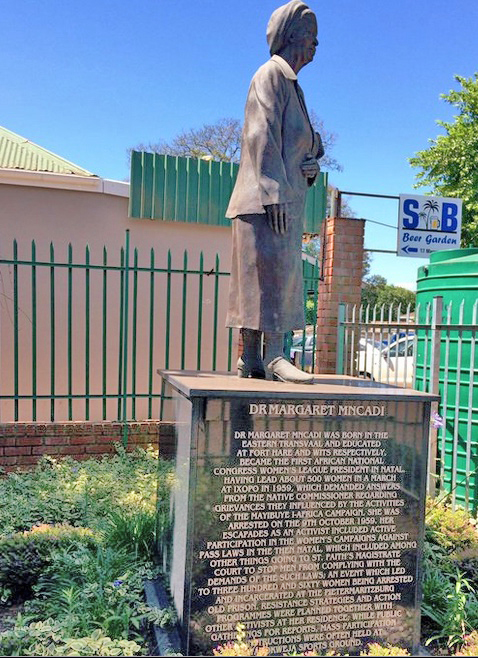
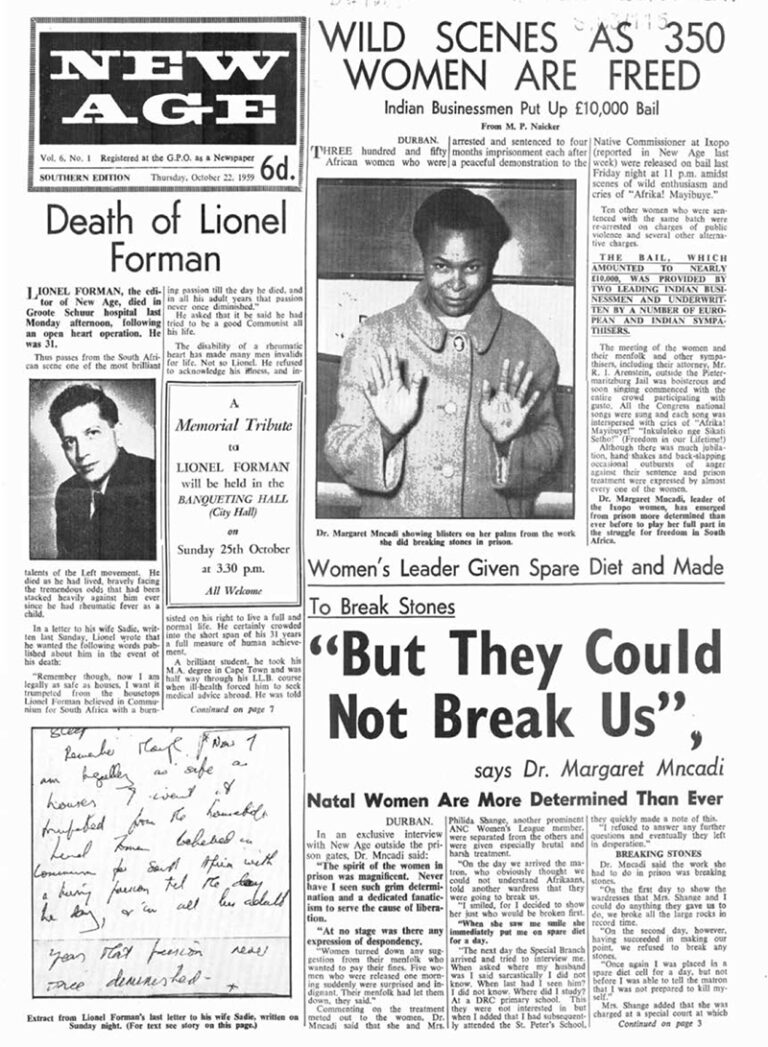
Margaret Chuene Mncadi was born in 1925. She graduated from the University of Fort Hare and Wits Medical School and was one of the first women in South Africa to become a medical doctor.
Mncadi was active in the ANC and in 1959 she was arrested and jailed for leading protests against the extension of passes to women. She was elected vice-president of the ANC Women’s League in Natal. In 1960 she went into exile in Eswatini, where she continued to practise medicine.
After that, I could find no biographic details apart from that there is a statue of her in the garden of the Ixopo library, which is named after her. Do please comment if you know more.
Whatever we call it, it remains an esplanade. A colonial creation, a public space for recreation and the marker of countless parallels.
Where trains carrying cars thunder alongside cars carrying people, whizzing past people pushing red-painted carts full of sugar and their hopes of survival.
Where coconut palms wave like a parade along a boulevard imagined by their planters. I so admire those who sow seeds knowing they will not sit in the shade of the trees.
Boulevard meaning: ‘a wide and usually important street that often has trees, grass, or flowers planted down its centre or along its sides’.
Where life is live-streamed across a ninth-floor window.
Birds draw invisible lines, commuting in a scattered dance.
Above the other world of the harbour, a world bounded by the Bluff, the railway, dry docks and wharfs.
A world described in a language of flashing lights, markers and radar.
Giant red iron cranes stand sentry or bend in service, reflected in the colour-coded depths of channels and sand banks. Tug boats cling like calves to mother whales against the sides of the vessels they guide through the narrow harbour entrance.
Ornate blue Victorian wrought iron railings run the length of the embankment, from the BAT Centre to Wilson’s Wharf. Matching lamp posts on the other side of the road have been disembowelled for the sake of a few rands worth of copper wire. The low stone wall built both sides of the railway line in 1860 is a work of precision and multi-functional beauty, or it was until 2024.
The wall served as a safety barrier but also as a seat, a vantage point, a place to watch the ships come in and the bait catchers wade out. A place to contemplate or kiss, to read or watch a soccer match. For 164 years. Until someone got a very stupid idea and someone else got a very lucrative contract to put ‘clear-view’ fencing topped with razor wire all along the embankment.
People still sleep on the grass, moving off in the mornings. People still play soccer. People still dump rubbish there. The municipal workers still pick it up. Criminals still hide behind trees and dash out to mug passers-by or steal batteries from parked cars. The fence simply stops anyone touching the wall or taking photos.
Issuing another lucrative contract for a fence on the far side won’t improve security. It will simply make one of the most beautiful public places in the city look like a maximum security prison compound. That is how Albert Park looks now – a public space closed to the public. Which is ironic considering the road is named after one of the leaders of the struggle for freedom.